
Skip to the tool

Free tool for trades pros

How bad is that lowball?

Paste the message a customer sent you. Get a lowball score, three polite replies that hold your price, and a card to share.

Free. No signup.

How it works

  1. Paste the message

    Drop in the text the customer sent and pick your trade. No signup, no email.

  2. Get the score and three replies

    See how hard they're pushing, which tactics they tried, and three polite replies that keep your price.

  3. Post the card

    Every score comes with a card sized for Instagram and Facebook. The worse the offer, the better the post.

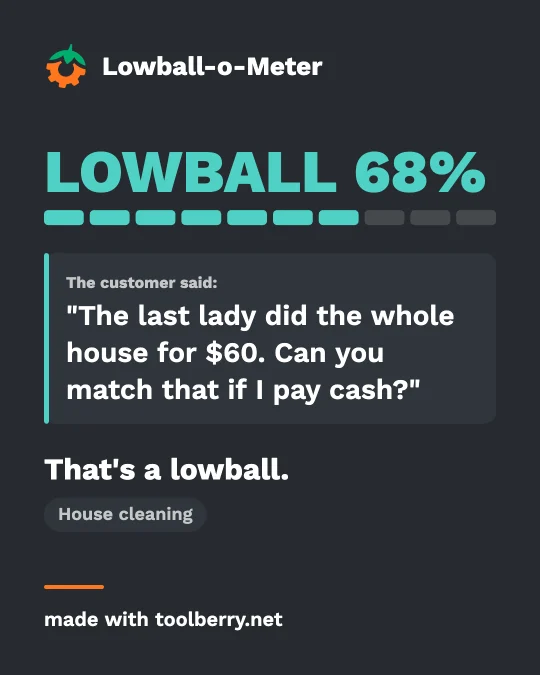
  • Lowball-o-Meter card: LOWBALL 68%, That's a lowball. The customer said: "The last lady did the whole house for $60. Can you match that if I pay cash?"
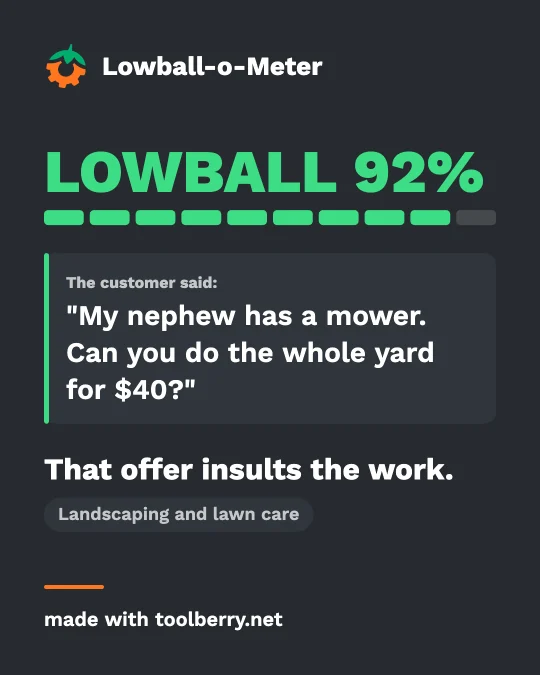
  • Lowball-o-Meter card: LOWBALL 92%, That offer insults the work. The customer said: "My nephew has a mower. Can you do the whole yard for $40?"
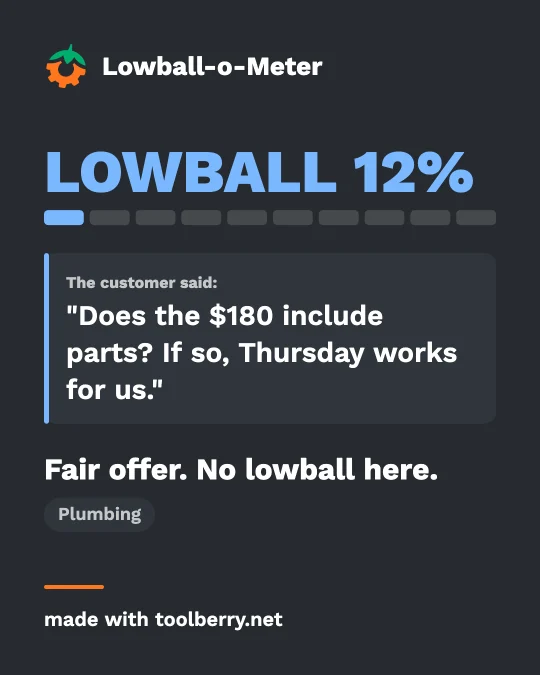
  • Lowball-o-Meter card: LOWBALL 12%, Fair offer. No lowball here. The customer said: "Does the $180 include parts? If so, Thursday works for us."

Every lowball deserves an audience

You've heard them all: the nephew with a mower, the "other guy" who does it for half, the cash discount that somehow comes to 50% off. Don't just grind your teeth. Score it, send a reply that keeps your price, then post the card and let other pros rate the damage.

Score your lowball

Both optional. Add them to see the gap. They stay on your device.

Your message is sent to our AI provider to be scored. We don't store it.

The ToolBerry app

Save your prices so the next counter takes 5 seconds.

ToolBerry is the free job tracker for trades pros: quotes, invoices, schedules and your own price list, even without signal.

No account · No credit card · Works offline

Handling lowball offers without losing the job

What counts as a lowball offer?

A lowball offer is a counter that asks you to do the same job for a price that doesn't cover what the job takes. It's different from a normal question about the price. Asking what's included, whether there's a discount for paying up front, or if a smaller scope would cost less is ordinary negotiation. A lowball goes further: it names a number far below your quote, leans on a tactic to get there, or treats the work as if it were worth next to nothing.

Most lowballs arrive as a short text. They tend to use the same handful of moves: a cheaper "other guy", cash in hand, a tight budget, the promise of more work later, or a price pulled from a website. Spotting the move is half of answering it well.

Why customers lowball

Usually it isn't personal. Many customers have no idea what a job costs to do properly, so they anchor on the cheapest number they have seen. Others negotiate out of habit, because it has worked for them before. Some are testing whether your price is firm. Very few expect you to accept a number that loses you money.

That's why the best replies stay friendly. You are not arguing with the person, you are declining the number. A calm answer that explains what your price covers keeps the door open, and a surprising share of lowballers go ahead at the quoted price once they see you won't budge.

How to answer a lowball and keep your price

Thank them, restate the price, and say what it includes. Keep it short: one or two sentences reads as confident, a paragraph reads as defensive. Avoid apologising for your price and avoid explaining your costs line by line unless they ask.

If you want to give them a way to say yes, change the job, not the price. Offer a smaller first phase, a simpler option, or a different day that suits your schedule. Dropping the price for the same work teaches the customer that your quotes are opening bids.

Answer the tactic, not just the number. A "the other guy is cheaper" message is best met by what makes your work different. A cash request is best met by one fair price for every payment method. A promise of future work is best met by earning it on this job at a fair price.

When to walk away

Some jobs are not worth winning. If a customer belittles the work, keeps pushing after a clear answer, or offers a fraction of a fair price, the job is likely to come with late payments and scope creep too. A polite, final reply that leaves your offer open is enough. You don't owe a long explanation.

Keeping your prices written down helps here. When your rates are saved in one place, you answer from a number you already decided on, not from how the message made you feel.

How the Lowball-o-Meter scores a message

The score comes from an AI model that reads the message and answers a fixed set of questions: whether it negotiates the price at all, how hard it pushes, and which common tactics it uses. It can only pick from those answers, so it never writes anything that ends up on your screen. The replies you see were written by people and are picked to match the tactic and your trade.

The score is a quick read, not a verdict on your customer. The same message can score a little differently from one try to the next, and a very short message is hard to read, which is when we tell you to take the score with a grain of salt.

If you add your quote and their offer, the gap is worked out on your own device from those two numbers. It isn't compared to anyone else's prices.

Questions

Is the Lowball-o-Meter free?

Yes. There's no signup, no email and no limit beyond a short pause if lots of people use it at once.

Do you keep the message I paste?

No. The message is sent to our AI provider to be scored and is not stored. Phone numbers and email addresses are removed before it's scored, but names and other details are not, so leave out anything you don't want to share.

Does it work in Spanish?

Yes. You can paste a message in English, Spanish, Portuguese or French, and the page itself is available in all four languages.

How is the score worked out?

The model places the message on a five-step scale from fair to insulting and lists the tactics it uses. The scale sets the score, and each extra tactic nudges it up within the same range.

Can I change the replies?

Please do. They are starting points. Copy one, adjust it to sound like you, and send it.

Where do my numbers go?

Nowhere. Your quote and their offer never leave your device: the gap is worked out in your browser.